
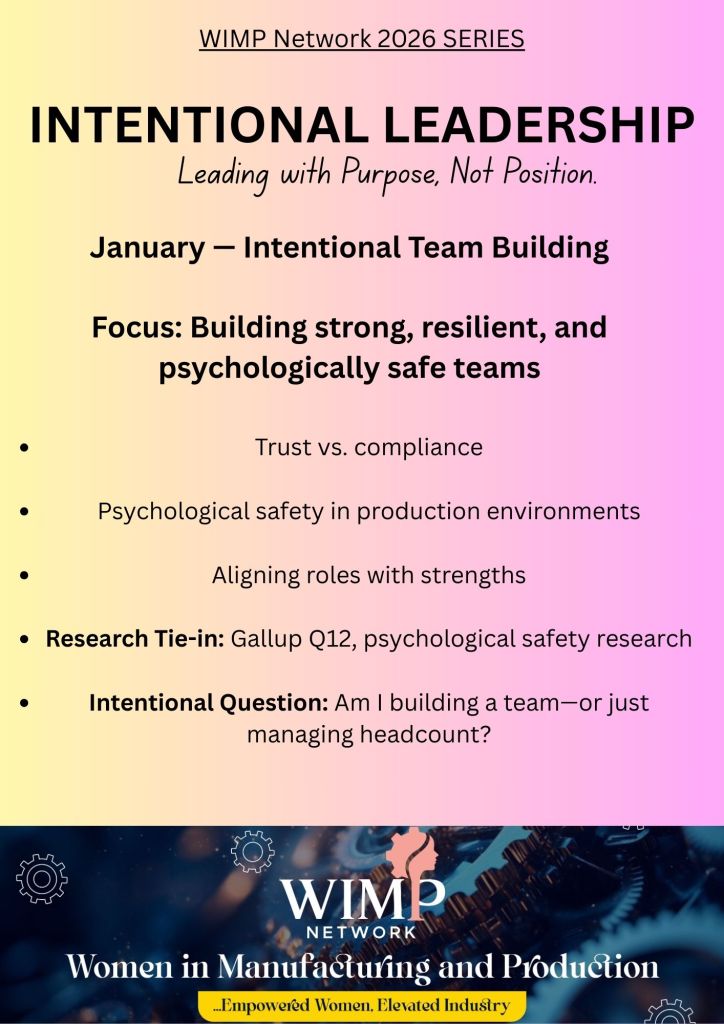
Intentional Leadership –January 2026
Building Strong Teams: Leading with Purpose, Not Position
As leaders in manufacturing and production, we often measure success by output—units produced, deadlines met, defects reduced. But at the start of a new year, it’s worth pausing to ask a deeper question:
Are we building strong teams—or simply managing people to meet numbers?
Intentional leadership begins with the understanding that results are a reflection of relationships. Behind every KPI is a human being showing up with skills, fears, strengths, and untapped potential. When leaders are intentional about team building, performance becomes sustainable—not forced.
Why Team Building Must Be Intentional in Manufacturing
Manufacturing environments are high-pressure by design. Tight schedules, safety risks, quality demands, and constant change can quietly push leaders into survival mode. In that space, leadership becomes reactive rather than deliberate.
Yet Gallup research consistently shows that high-performing teams are not the result of luck or proximity—they are built through trust, clarity, and engagement. Teams that feel valued, heard, and psychologically safe are more likely to:
- Take ownership of their work
- Speak up about quality and safety concerns
- Support one another during high-demand periods
Strong teams don’t happen by accident. They happen by choice.
From Managing Tasks to Leading People
Intentional team building requires a shift in mindset:
- From command and control → to connection and collaboration
- From fixing people → to developing people
- From authority-based leadership → to trust-based leadership
This does not mean lowering standards. It means raising the level of leadership maturity.
Three Pillars of Intentional Team Building
1. Psychological Safety Comes First
Teams perform best when individuals feel safe to speak up—especially in environments where silence can lead to defects, rework, or safety incidents.
Ask yourself:
- Do my team members feel safe admitting mistakes?
- Do I respond with curiosity or blame?
- Do I encourage questions—or discourage them with urgency?
Intentional leaders create spaces where people can be honest without fear of embarrassment or retaliation.
2. Strengths Over Similarity
Too often, leaders build teams that look and think like them. Intentional leaders do the opposite.
Gallup’s strengths-based research shows that teams are stronger when individual strengths are understood, respected, and strategically aligned. This means:
- Knowing who thrives under pressure
- Recognizing who brings calm, precision, or creativity
- Pairing complementary skills intentionally
Strong teams are not uniform—they are balanced.
3. Trust Is Built in the Small Moments
Trust isn’t built during annual reviews. It’s built daily:
- Keeping your word
- Listening without interrupting
- Following through on commitments
- Giving credit publicly and feedback privately
In manufacturing, trust is currency. When trust is high, communication improves. When communication improves, quality and safety follow.
The Leader’s Role: Builder, Not Hero
Intentional leaders understand that leadership is not about being the smartest person in the room—it’s about creating a room where everyone can contribute their best.
You are not there to carry the team.
You are there to build the team.
Reflection for January
As you begin 2026, take time to reflect:
- Who on my team feels most supported by me?
- Who might feel unseen or unheard?
- Where have I been reactive instead of intentional?
- What one action can I take this month to strengthen trust?
Small, consistent actions shape strong teams.
WIMP Leadership Call-to-Action
At WIMP, we believe leadership is a responsibility, not a title. This month, we challenge you to:
- Have one intentional conversation with a team member
- Ask about their goals, not just their tasks
- Listen more than you speak
Strong teams build strong industries—and women leaders are essential to that future.
 WOMEN IN MANUFACTURING AND PRODUCTION